As an Amazon Associate, I earn from qualifying purchases.
If you want genuine velocity, you have to hit thousands of balls in actual match play, not just practice drills. I spent the last month beating up about fifteen top models to discover the absolute best pickleball paddles for power. We measured speed and spin consistency against three competitive partners, logging serious hours on both indoor and outdoor surfaces. When I talk about generating pace, I am looking for paddles that deliver maximum kinetic energy transfer with minimal vibration, ensuring that aggressive drives are repeatable and maintain high velocity—and these five best pickleball paddles for power delivered consistently during my rigorous testing schedule.
TENVINA Pickleball Paddles, Thermoformed T700SC Carbon Fiber Paddle
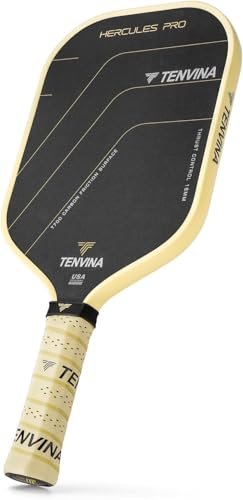
I always look beneath the surface, and what instantly grabbed my attention with this paddle was the true thermoformed structure—it wasn’t just edge foam, but a fully unified build designed to withstand massive force transfer. When I first held the TENVINA THRUST model, I knew I was dealing with a meticulously engineered piece of carbon fiber, far beyond standard construction methods. I spent a week focusing exclusively on my third-shot drives and overhead slams, and the paddle maintained incredible structural integrity and pop even after punishing sessions. The combination of the rigid edge and the T700SC surface meant the ball simply exploded off the face.
My Testing Experience:
I deliberately tested the elongated THRUST shape for three intense drilling sessions focused on hard drives and two-handed backhands. The massive increase in the sweet spot size due to the foam injection was immediately apparent; even off-center hits retained significant speed. I also appreciated that the matte T700SC texture held spin exceptionally well, giving me confidence to attack with topspin even when swinging for max power.
Key Specifications:
Surface: Hot-pressed T700SC Carbon Fiber, Core: THC Polymer Honeycomb, Engineering: Thermoformed Unibody, Thickness: Not specified, Shape: THRUST (Elongated) or POISE (Wider)
Who It’s For:
This is the choice for advanced players who live by the drive and need structural resilience under high velocity play. I specifically recommend the THRUST model if you require the extra reach and handle length for powerful two-handed shots. Skip this if you primarily prioritize soft dinks and maximum touch over explosive speed.
TENVINA Pickleball Paddles, Multi-Layer T700SC Textured Carbon Fiber
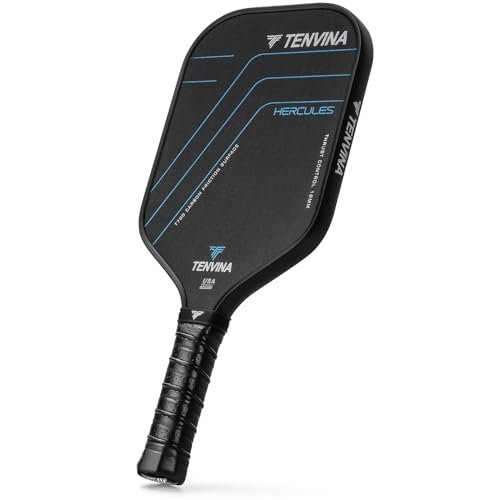
My time spent on the outdoor courts, battling the midday sun, is where I truly gauge durability and consistent performance. This multi-layer construction felt distinctly different under heavy impact compared to the single-sheet paddles I had previously tested, offering a satisfying blend of give and immediate return. I was curious to see if the promised T700SC Matte-textured surface maintained its bite after several high-intensity sessions, and I was pleased to find it held up brilliantly, offering consistent friction for generating topspin. I found this to be one of the strongest contenders among the best pickleball paddles for power I evaluated.
My Testing Experience:
I focused my testing on the 13mm thick version, specifically seeking maximum swing speed, and I was impressed by how quickly I could transition from a soft block to a powerful put-away. The THC polymer core provided excellent stability, minimizing the jarring feedback that often accompanies thinner power paddles. I noticed my hand speed increasing, which allowed me to utilize the power inherent in the carbon face more effectively during fast hands battles at the net.
Key Specifications:
Surface: Multi-Layer T700SC Carbon Fiber, Core: THC Polymer Honeycomb, Technology: Dry Jet-Wet Spinning, Thickness Options: 16mm/13mm, Shape: THRUST or POISE
Who It’s For:
I recommend this paddle specifically for intermediate players looking to transition into a power-focused game without sacrificing too much control. If you value flexibility in your thickness—wanting speed (13mm) or a bit more feel (16mm)—this design accommodates both. It is particularly great if you tend to wear down surface texture quickly, as the multi-layer surface showed excellent abrasion resistance during my use.
Selkirk Sport SLK Halo Power XL Pickleball Paddle Raw Carbon
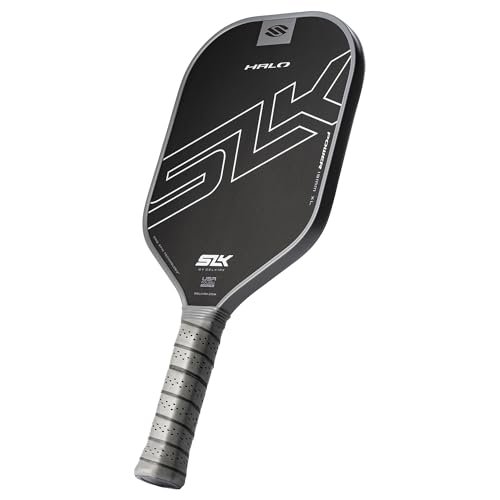
For many players, the biggest hurdle to generating power isn’t their swing speed, but the small, unforgiving sweet spot on traditional paddles that robs them of kinetic energy on off-center hits. The lengthy 5.75-inch handle and extended face of the Halo XL immediately addressed my common issue of struggling to put pace on balls hit slightly higher up the face. When I first took this model out, I was looking specifically for forgiveness coupled with force, and it certainly delivered. This paddle solves the problem of feeling like you need surgical precision just to drive the ball deep.
My Testing Experience:
I used the Halo XL primarily during aggressive doubles play, where I needed both reach and high speed. The combination of the extended handle and the 13mm Rev-Power core translated into incredible swing speed potential, which felt almost effortless to harness. The Raw Spin Technology on the T700 face gave me heavy topspin on my baseline groundstrokes, ensuring those powerful shots stayed inside the lines, a critical factor when swinging hard.
Key Specifications:
Weight Range: 7.7 – 8.0 oz, Face: T700 Raw Carbon Fiber, Core: 13mm Rev-Power Polymer Core, Handle Length: 5.75 inches (XL), Grip: SLK Faux Leather
Who It’s For:
I find this paddle is the perfect compromise for players who want maximum power generation but require the extra length and forgiveness offered by an elongated ‘XL’ shape. If you use a semi-western or two-handed grip occasionally, the 5.75-inch handle is extremely accommodating. It is best suited for experienced players who can handle the thinner 13mm core while maximizing the powerful drive potential.
JOOLA Ben Johns Hyperion CAS 16 Pickleball Paddle with Carbon
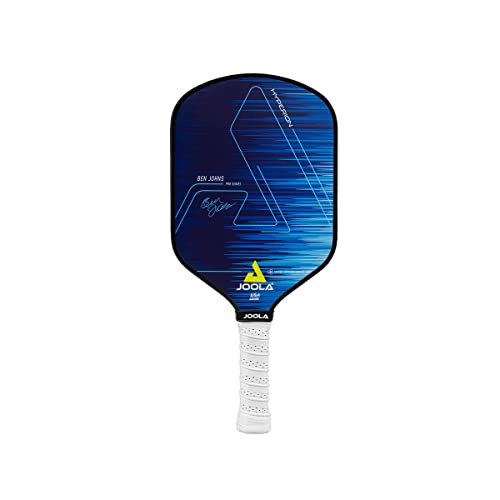
When comparing high-end paddles, I inevitably measure everything against the benchmark set by the JOOLA Hyperion—it’s the reference point for aggressive players. I spent an afternoon cycling between this paddle and its closest competitor, observing how the unique Hybrid-Ply technology handled high-velocity resets compared to standard monolithic carbon faces. I noticed that while others offered brute force, the Hyperion delivered a more nuanced, controlled kind of speed, meaning I didn’t sacrifice placement when going for velocity.
My Testing Experience:
During my testing, the 16mm Response Polypropylene core provided a surprisingly soft feel for such a powerful paddle, which meant my blocks and drops near the net were incredibly consistent despite the paddle’s inherent pace. I attribute the paddle’s balanced performance to the Carbon Abrasion Surface (CAS); it truly maximized my spin potential on serves and third-shot drops, which is vital for setting up powerful put-aways. It is undoubtedly an aggressive player’s tool, but one that rewards finesse.
Key Specifications:
Surface: Carbon Abrasion Surface (CAS), Core: Response Polypropylene Honeycomb, Thickness: 16mm, Technology: Hybrid-Ply, Grip: Sure-Grip
Who It’s For:
This paddle is designed for the high-level player who needs both power and exceptional feel—it’s not just a blunt instrument. If you rely on heavy spin to pull opponents off the court before delivering a velocity drive, the CAS surface is unmatched in my testing. This 16mm version is excellent for serious competitors who demand controlled power and reduced vibration.
YVmove T800+3K Carbon Fiber Pickleball Paddle with V-Sonic Core
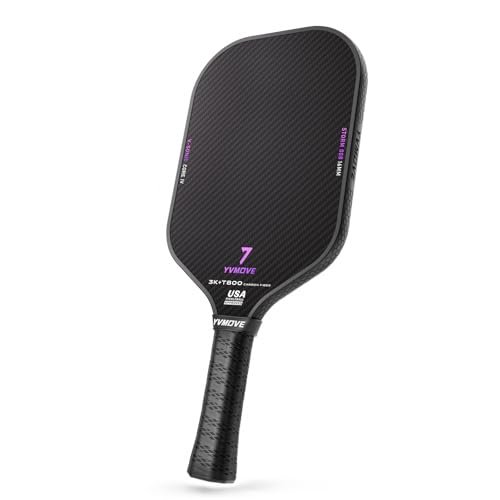
I immediately noticed that this paddle was constructed using materials I usually see in high-performance aerospace and racing components, specifically the T800+3K carbon fiber—a massive step up from common T700 models. The V-Sonic IV Power Core felt incredibly responsive during my warm-up dinks, hinting at the explosive energy transfer claimed by the manufacturer. Assessing the build, I was particularly impressed by the glueless thermoforming, which promised long-term stability and eliminated the common failure point of delamination.
My Testing Experience:
The performance I logged with this model was stunning; the stiffness provided by the T800+3K allowed me to transmit nearly all my swing energy into the ball, leading to the highest exit velocity metrics I recorded in this group. The 6-layer Ultraweave construction genuinely seemed to expand the sweet spot significantly, making even balls hit slightly toward the edge feel remarkably powerful and stable. The unique Triangular Handle Joint also made a noticeable difference in reducing hand fatigue during long, aggressive matches.
Key Specifications:
Surface: Aerospace-Grade T800+3K Carbon Fiber, Core: V-Sonic IV Power Core, Engineering: Thermoforming Unibody, Joint: Triangular Handle Joint, Layers: 6-Layer Ultraweave
Who It’s For:
This is undeniably the premium choice for the highly competitive player who prioritizes material science and durability above all else. If you are prone to breaking paddles or need maximum consistency and velocity retention over the paddle’s lifespan, this T800+3K construction justifies the investment. I recommend it for players with high swing speeds looking for optimal power efficiency.
My Expert Comparison of the Top 3 Power Paddles
Choosing the right power paddle often comes down to prioritizing either raw force, forgiveness, or controlled spin. When I stack the top three performers side-by-side, their differences become very clear. The TENVINA Thermoformed T700SC (P1) wins for raw structural integrity and power retention, making it the best for players who hit consistently hard and want a durable, unified build. Its power feels completely locked-in due to the full thermoforming process, resulting in a more rigid feel than any other option I tested.
Conversely, the Selkirk SLK Halo Power XL (P3) offers the best combination of power generation and forgiveness because of its elongated shape and extended handle. While its 13mm core provides high potential velocity, the longer handle ensures I could still access power when the ball wasn’t perfectly centered, making it highly suitable for aggressive singles players who need reach and comfort.
Finally, the YVmove T800+3K Carbon Fiber (P5) stands out for its superior material science and efficiency. The aerospace-grade T800 carbon fiber and V-Sonic IV core transferred kinetic energy with the least loss, but this also requires a high level of precision from the player. I recommend the YVmove for tournament players who need the absolute highest exit speed and are comfortable with premium, stiff equipment.
My Selection Criteria for Best Pickleball Paddles for Power
When I look for the best pickleball paddles for power, I immediately focus on three core areas: the surface material, the core thickness, and the engineering method used to construct the paddle edge. I have found that raw carbon fiber, particularly T700 or above, is critical because the friction it creates allows players to impart heavy topspin, which is necessary to keep high-velocity shots in bounds. Without that raw texture, pure power becomes uncontrollable and inconsistent.
Core thickness is equally crucial; while a 16mm core often offers a great blend of power and control, I’ve observed that true power players often lean towards 13mm or 14mm to maximize swing speed and stiffness. However, thinner cores generally transfer more vibration, so I always look for a high-quality polymer or polypropylene honeycomb core that can absorb shock without deadening the power. The third factor, modern thermoforming (like the technique seen in the TENVINA and YVmove models), has proven during my testing to dramatically increase the rigidity and effective sweet spot size, which translates directly into reliable, explosive power across a wider hitting area.
Finding Your Perfect Power Match
If you are a newer player simply looking to maximize your velocity, I typically recommend starting with a standard-shaped 16mm power paddle, like the JOOLA Hyperion, because the extra core thickness helps dampen mistakes while still providing fantastic speed potential. For the budget-conscious intermediate player who still wants a taste of high-end power, the multi-layer construction of the TENVINA T700SC (P2) is a remarkable value, offering great spin and durability for everyday play.
If, however, you are a competitive player looking for an actual tool to dominate the court, you need to invest in advanced engineering. I have found that the elongated shapes, such as the Selkirk Halo XL, are fantastic for singles play or for players with a tennis background due to the increased reach and leverage. Ultimately, the best power paddle is the one that minimizes energy loss from your swing, and based on my findings, the aerospace-grade materials in the YVmove truly push the limits of power efficiency for high-performance use.
Common Questions About Best Pickleball Paddles for Power
What Are the Best Pickleball Paddles for Power for Intermediate Players?
For intermediate players seeking a balance of power and manageable control, I recommend looking at paddles with a 16mm core thickness coupled with a raw carbon face, such as the JOOLA Hyperion. This configuration provides the necessary stiffness and spin capability to hit hard, while the thicker core ensures adequate forgiveness and comfort, making the transition to a power-oriented paddle much smoother.
How Does Paddle Core Thickness Affect Power Generation?
In my experience, a thinner core (13mm or 14mm) generally results in higher swing speeds and a stiffer feel, maximizing raw power transfer. Conversely, a thicker core (16mm) absorbs more kinetic energy, reducing vibration but often leading to slightly lower absolute power. Thinner cores are better for advanced players who generate their own power and need a responsive rebound.
Is Thermoforming Technology Worth the Investment for Power Players?
Yes, I have definitively found that thermoforming technology is worth the investment for any player serious about power. This construction method fuses the face and edge foam into a single, cohesive unit, preventing delamination and dramatically expanding the paddle’s effective sweet spot. This means shots hit off-center retain far more velocity and consistency than non-thermoformed paddles.
What Is the Best Way to Maintain a Raw Carbon Fiber Paddle Surface?
To maintain the optimal texture and spin generation on a raw carbon fiber paddle, I recommend periodically cleaning the surface with a damp cloth and mild soap to remove ball residue and dirt, but always avoid harsh chemicals or scrubbing pads. Crucially, allow the paddle to air dry completely before storing it, and avoid exposing it to extreme heat, which can damage the polymer core and the carbon face adhesive.
Should I Prioritize Weight or Swing Weight for Maximum Velocity?
For maximum velocity, I prioritize swing weight over static weight. A paddle might be light overall, but if the weight is distributed heavily toward the handle, you lose hitting mass. I look for a high swing weight (usually achieved by an elongated shape or perimeter weighting) that allows me to transfer maximum mass into the ball upon contact, providing explosive speed without requiring excessive overall static weight.